2021 has been here for some time. What about your good intentions and improvements of (bad) habits?
You can now start over, tackle your goals, learn better habits, and get rid of the bad habits that no longer serve you.
After such a challenging period for all of us, it is time to hold the reset button and take a more beautiful path that awaits us.
The Stoic philosophers give us a roadmap for a substantive and composed life. Their wisdom can help you succeed by choosing and deciding how to respond to the chaos around you.
Below are some key concepts from Stoic philosophy that will help you learn good habits that can positively change your life.
Stop worrying about other people's opinions.
Like Marcus Aurelius wrote in his "Meditations":
It never ceases to amaze me: we all love ourselves more than other people, but care more about their opinions than ours.
Caring more about the opinions of others than how you see yourself is a slippery slope. After all, you cannot always satisfy everyone. Whose opinion is really important to you? Maybe your best friend or life partner's, and yours. Then listen to them, shut out other people's noise, and don't become a slave to the perceptions of others.
Make sure you're working on something that matters.
"Work feeds noble minds"Seneca wrote. Work, the deliberate pursuit to produce something of value to others, is a big part of being human.
So if your goal is to achieve satisfaction, an important place to take a closer look is what you're spending time on.
Does your job fill your days with a sense of purpose and mission? Or is work really just consuming energy because you feel like just a cog in a machine, powerless and just working to realize the dreams of others instead of your own?
Stop striving for perfection.
As a maker and being a creator, this is a difficult one. We all strive to be the best we can be, as a parent, at work, or in our personal life.
However, as Epictetus stated:
"We are not leaving our pursuits because we are desperate to ever perfect them."
We know we will never be perfect in whatever we do. This shouldn't stop us, and it shouldn't stop you. Don't let it happen - perfection is an elusive lofty goal, but nothing more than an illusion. The most important thing is to do, keep moving and keep taking steps!
Start a routine of reflection.
In his "Discourses" Stoic philosopher Epictetus invites you to ask yourself some important questions before starting your day.
In the morning, ask yourself the following question:
What am I missing now for gaining freedom to my passion?
What kind of rest?
What am I? Just a body, holder or reputation? None of these things.
What then? A rational being.
What is required of me then? Meditate on your actions.
How did I get away from serenity?
What have I done that was unkind, anti-social, or indifferent?
What have I not done in all these things?
Taking the time each day to ask yourself these important questions (or your own variation on them) can help you stay on track. Day after day, year after year, they will give you clarity as you move through your life and keep taking steps.
Welcome setbacks and obstacles on your way.
Seneca brilliantly reminds us that meeting challenges is the only way to measure ourselves. To see what you are really made of and what you can achieve.
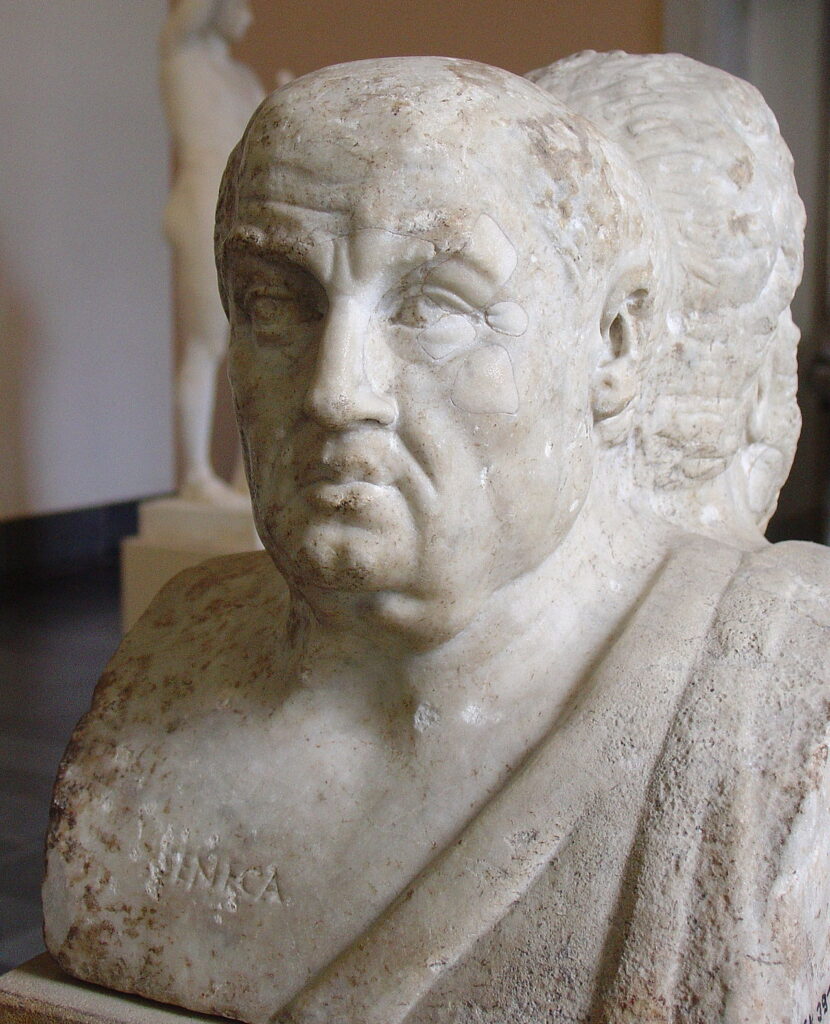
“I think you are unhappy, because you have never been in an accident. You've gone through life without an opponent - no one can ever know what you're capable of, not even you. “
Instead of avoiding challenges and inconveniences, think of these two as friends who will help you grow. Getting out of your comfort zone is the only sure way to become the best version of yourself.
And Epictetus agrees:
Difficulties show the character of a person. Therefore, when you encounter a difficulty, remember that God, as a trainer of wrestlers, has compared you to a tough young man.
Why? So you can become an Olympic wrestler but that is not possible without sweat.
So don't be afraid of the sweat, embrace it. It's what will get you closer to your goal (even if you're not aiming for Olympic gold as a wrestler!). According to the Stoic philosophy so don't be afraid of “problems” on your way, by dealing with them you will grow!
Remember to die.
The old saying, memento mori, was used as a constant reminder of the temporary nature of this life. In the scheme of things your life is nothing but a short, passing wave in the endless ocean of human history. So you better make the most of the time you have on this Earth!
Aurelius, again:
You could leave life now. Let that determine what you do, say and think.
Thinking this way forces you to strive to be the best version of yourself from moment to moment.
Set a good example.
It's easy to get lost in principles, concepts, and tips to live a 'good' life or be a 'good' person. At the end of the day, actions speak louder than words.
Instead of endless debates about morality and gossip about this or that person's actions, act like the person you want to be.
Aurelius simply stated:
Don't waste more time arguing about what a good man should be. Be one.
Appreciate simplicity.
Our world of uncontrolled consumerism makes us think that consuming is an end in itself. However, the current global pandemic has prompted many to rethink their priorities and to rethink what really matters in this life.
As Seneca advises:
Let's get used to eating out without the fuss, to be of service to fewer slaves, to buy clothes only for the real purpose, and to live in more modest rooms.
Do we own things, or do things own us? If a person is so attached to his home, his big cars and expensive bags, he is actually a slave to these lifestyle and inanimate objects. Let's flip the script and stay the masters of our lives by avoiding unnecessary clutter that doesn't help us grow.
Accept the world as it is.
We always cling to external events and what people have told us or what they have done, with anger and bitterness trapped inside. It's easy to find excuses by blaming how people have treated you in the past. What kind of childhood did you have. Or on an unprecedented global economic and health crisis ...
Yet Aurelius makes us think about how we perceive things that are beyond our control:
If you are tormented by something from the outside, it is not this thing that is bothering you, but your own judgment about it. And it is in your power to erase this judgment now.
When you "erase this judgment," you free yourself from the pain that you cause yourself if you want to be in control of events that you cannot control.
Concluding Thought on Stoic Philosophy
Stoicism as a way of life can be summed up by another musing of Aurelius:
Objective judgment - right now, right now.
Selfless action - right now.
Willing acceptance - now, right now - of all external events.
That's all you need.
These 3 important things are the key to a stoic life: one of acceptance, not guilt. One of letting go, not of attachment to the result.
If you can be flexible enough to stop wanting to bend the world to your liking so that everything goes your way, you will live a much happier life.
Sources include AmericanHumanist (link), KRCW (link), Medium (link, link)